REVIEW · PUERTO DEL ROSARIO
Fuerteventura: The Panoramic VIP island Tour. All HOTSPOTS!
Book on Viator →Operated by FuerteTickets · Bookable on Viator
Corralejo to caves, all in one day. This Panoramic VIP route is built for big views and real island stops, from Corralejo’s dunes to the Ajuy cave walk. I like how it stays relaxed even with lots of ground to cover, and I really like the small-group setup (max 8) with local stories you actually remember.
One thing to plan around: this is a mountain-heavy day, so bathroom breaks aren’t frequent. If you need lots of stops on short notice, this won’t feel comfortable.
In This Review
- Key Highlights You’ll Care About
- What Makes This Panoramic VIP Tour Worth Your Day
- Corralejo Dunes (And When Popcorn Beaches Take Over)
- Ajuy and the Caves Walk: Deep Time in 45 Minutes
- Betancuria Old Town: Stroll Time in a Real Historic Center
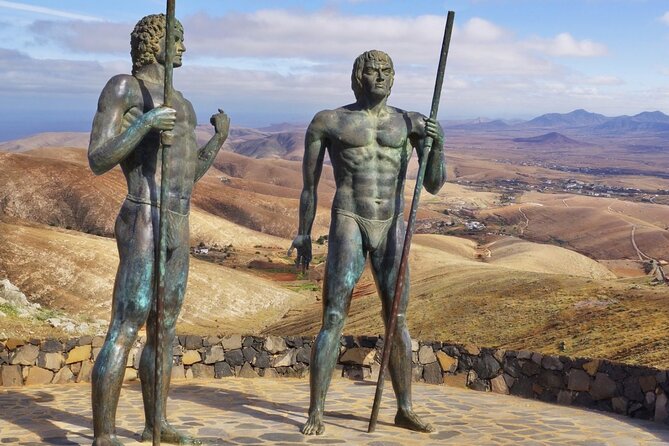
- Mirador Guise y Ayose: 669 Meters of Storytelling
- Las Peñitas: The Desert Oasis Made by People
- Sicasumbre: A Viewpoint Built for Watching the Sky
- Vallebrón: A Protected Ridge With Ravines and Archaeology Nearby
- Vega de Río Palmas and La Peña: Film-Spot Value Plus a Church Stop
- Ermita de la Peña: A Quick Church Check If Time Allows
- Tindaya and Casa Alta: Witches, Majos Rituals, and Sacred Meaning
- Pájara, Hermitage of Nuestra Señora de la Caridad, and the Island’s Earlier Settlements
- Tindaya’s Natural Monument Status and Endemic Plants
- Unamuno Monument and Tefía’s Agricultural Prison Colony (Franco Era History)
- La Oliva and Puerto del Rosario: Capital Changes, Port Views, and the Sea Pool
- How Long It Feels: Timing, Stops, and Why the Group Size Matters
- Price and Value: What $95.58 Buys You in Real Terms
- Who Should Book This Tour (And Who Should Skip It)
- Final Call: Should You Book This Fuerteventura Panoramic VIP Tour?
- FAQ
- How long is the Panoramic VIP island tour?
- Do I get pickup from my hotel or cruise port?
- Is the tour in English?
- How big is the group?
- What’s included in the ticket versus what costs extra?
- Are there any areas where pickup is not offered?
- What happens if the weather is bad?
- Is this tour suitable for motion sickness or frequent bathroom needs?
Key Highlights You’ll Care About

- Corralejo dunes (or popcorn beaches) if the weather plays nice, with quick photo time
- Ajuy Caves walk with entry included and deep-time geology lessons
- Betancuria Old Town for strolling, plus a low-cost cathedral add-on if open
- Miradors with meaning, from Guise y Ayose to Las Peñitas and sky-gazing at Sicasumbre
- Tindaya legends and petroglyph context, not just a quick viewpoint stop
- Short group, not rushed, using a modern air-conditioned minibus and slow tourism
What Makes This Panoramic VIP Tour Worth Your Day
Fuerteventura isn’t one of those islands that rewards you for speed. It rewards you for stopping—at viewpoints, in small towns, and at places where the geology tells a story. That’s exactly how this day trip is designed: a chain of highlights from north to interior, with just enough time at each stop to see what matters without feeling like you’re sprinting through the day.
You’ll start in Puerto del Rosario (pickup is offered for hotel and cruise guests), and you’ll be moving for about 6 to 7 hours total. The best part for many people is the group size: up to 8 travelers. Less crowding means fewer missed photo angles, and it also makes it easier to hear the guide when the van pulls over.
And the tour leans into a VIP feel without pretending it’s a private driver experience. You still get frequent stops and local history, but the vibe stays calm. Even the tour wording pushes slow tourism and no stress, and the itinerary supports that.
Corralejo Dunes (And When Popcorn Beaches Take Over)
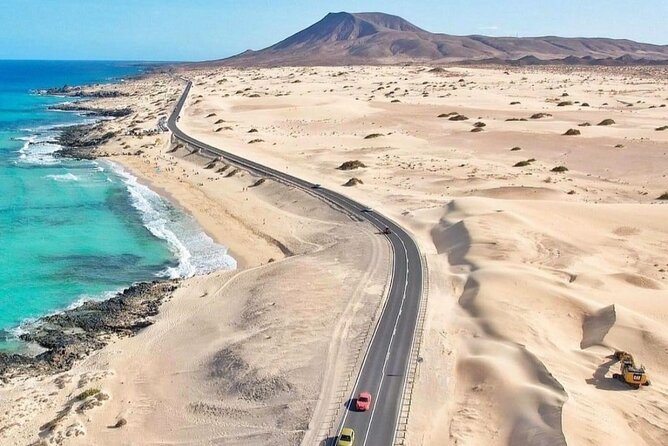
The tour kicks off at Dunas de Corralejo, the classic “this feels unreal” start. Your guide may call Corralejo the door to paradise, and it’s easy to see why: huge sand, strong light, and that dramatic edge where desert-ish dunes meet the sea.
Timing is short—about 10 minutes—but that first burst matters. It gets you oriented and it gives you a clean sense of what the island looks like on its best days. If weather conditions are nice, you may instead stop at the so-called popcorn beaches (another quick hit for beach texture and photos).
What I’d do if I were choosing my moment: aim for early shade comfort if you’re getting sweaty. Corralejo sun can be a lot, and this stop is brief enough that you’ll want a clear plan: camera up, quick walk, then back on the bus.
Ajuy and the Caves Walk: Deep Time in 45 Minutes
If Corralejo is your visual warm-up, Ajuy is your mind-bending main course.
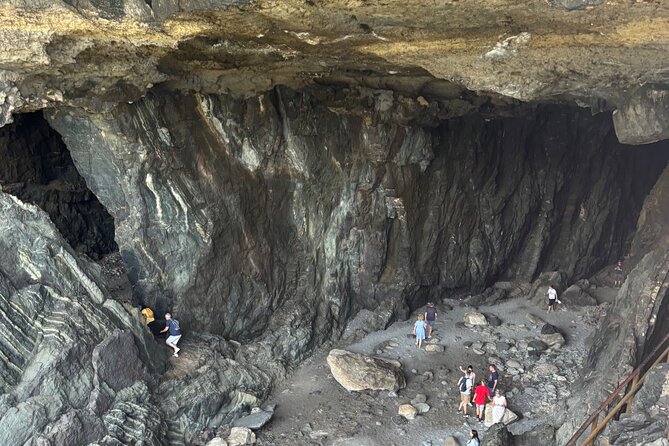
You’ll head to Playa de Ajuy for a caves walk (about 45 minutes). Entry is included, which is a practical detail—because nothing kills momentum like stopping to negotiate tickets at the exact moment you want to start walking.
The big draw here is geology. These caves tie back to how Fuerteventura formed: an ancient basal complex built from submarine lava and sediment, rising to the surface roughly 100 million years ago. The guide also frames it as a “travel back in time” experience, with rocks that originally formed deep under the ocean (described as coming up from around 3,000 meters).
Ajuy also has a layered human history. It was the landing spot of Jean de Béthencourt in the 15th century, linking the island’s early conquest story to the same coast where you’re now staring at geological formations.
How to make the walk easier: wear grippy shoes. Even if you’re not doing a long hike, cave areas tend to mean uneven ground and uneven footing. Bring a light layer too—coastal air can shift as clouds move.
And if conditions allow, the tour may add caves on the west sea coast too. That’s not something you’d count on, but it’s a nice bonus when it happens.
Betancuria Old Town: Stroll Time in a Real Historic Center
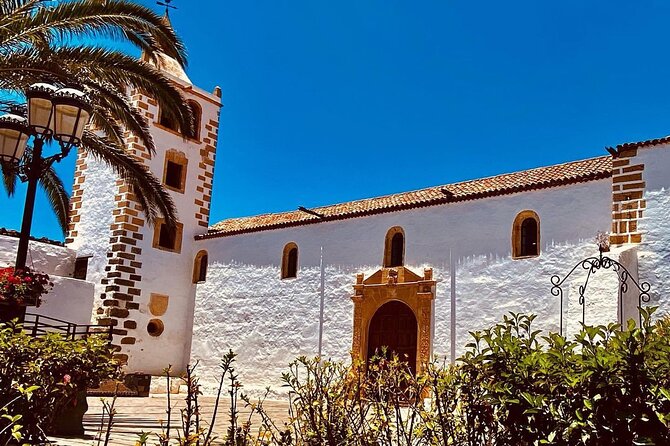
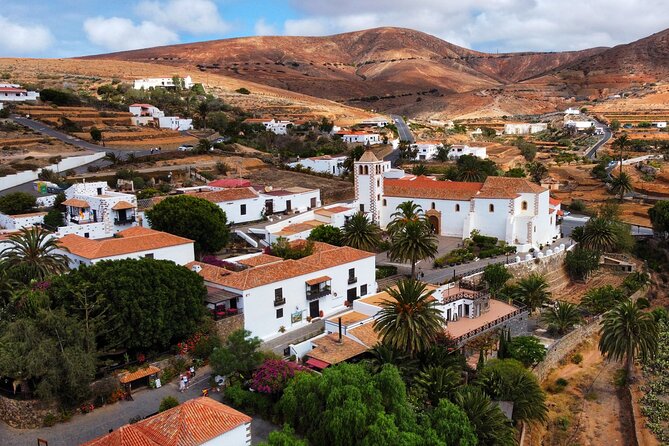
Next you get a break from pure nature and into old town pace. Betancuria Old Town is a proper change of gear—quiet streets, small-town feel, and just enough time to let your brain catch up.
You’ll have around 30 minutes of free time to stroll. If you want a church stop, Santa Maria Cathedral is an option, but it’s a small extra cost (2€) and only if it’s open. You can also grab a coffee or do some shopping.
This is one of those stops that feels simple, but it’s important. If all you saw today were viewpoints, you’d miss the island’s “everyday culture” texture. Betancuria gives you that.
Practical tip: if the cathedral is open, decide quickly. You’ve only got a half-hour, and the tour continues. A quick look usually beats rushing to everything.
Mirador Guise y Ayose: 669 Meters of Storytelling
After the old-town reset, you climb back into the “look up” part of Fuerteventura. Mirador Guise y Ayose is a short stop (about 10 minutes), but it’s designed for quick wow-factor.
You’re up in the mountains at about 669 meters, and the view is paired with two statues of the Guanches. That pairing matters because it turns a photo stop into a context stop. You’re not just taking a picture—you’re learning what you’re looking at and why these pieces are placed here.
This is also where a good guide helps: the explanation turns the scene from random scenery into something more readable.
Las Peñitas: The Desert Oasis Made by People
Mirador de las Peñitas is one of my favorite kinds of stops on Canary Islands tours: a viewpoint with a twist.
You’ll have about 10 minutes here. From the viewpoint, you’ll see an oasis-like green patch in the middle of the desert. The story is that an underground river flowing under the Las Peñitas ravine was created by human hands back in 1937, forming a small lake dotted with native plants.
That means the view isn’t only about nature. It’s about a human intervention that became part of the ecosystem. Add in that the open esplanade is good for photography, and you’ve got a stop that’s fun even if you’re not a serious photographer.
Also: chipmunks live there. It’s a small detail, but it’s the kind of detail that makes people smile and slows the moment down just enough to enjoy it.
Sicasumbre: A Viewpoint Built for Watching the Sky
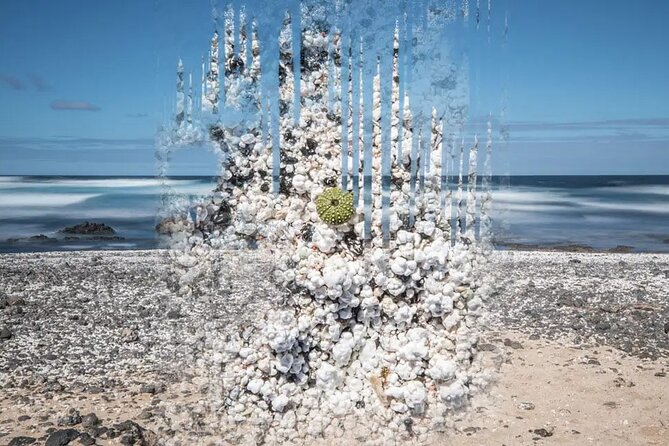
Next is Mirador Sicasumbre (about 15 minutes). The tour description frames it as one of the island’s better places to observe the sky, which makes sense because the facilities here include information and signage, plus the viewpoint setting works well for cameras.
The van comes by when weather conditions are favorable, and the guide makes it sound like this stop is about clarity. Even on a cloudy day, you usually get a good sense of the mountain layers and depth.
If you’re the type who loves star talk, night-sky talk, or just “let’s see what the clouds are doing,” this is your stop.
Vallebrón: A Protected Ridge With Ravines and Archaeology Nearby
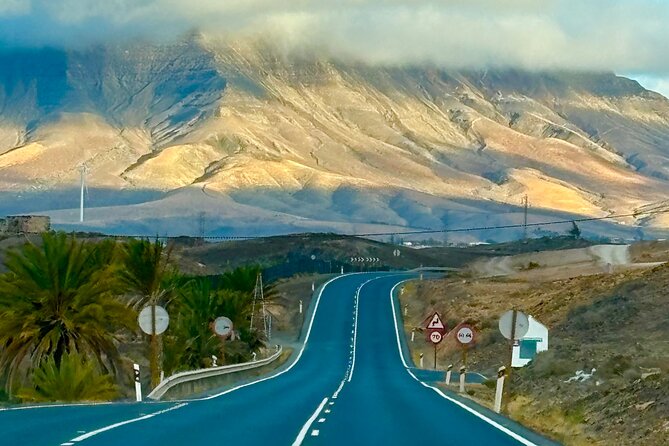
Mirador de Vallebrón is another about 15-minute stop, and it adds a “how the island is shaped” layer.
Vallebrón is described as a protected landscape between La Oliva and Puerto del Rosario, covering nearly 1,680 hectares (about 3.5% of the island’s protected area). The shape matters here: an elongated ridge with a knife-like relief, flanked by two large U-shaped ravines—Valle Largo and Valle Chico.
There’s also historical interest nearby. The southernmost point aligns with Montaña de la Muda, where there’s an archaeological site. And the area ties into Tindaya too, with reference points around Montaña Quemada and Montaña de Tindaya.
What you should do at this stop: treat it like a “read the terrain” moment. Take a breath, look for the ridge line, then look for the ravines. Once you see the shapes, the island stops looking random.
Vega de Río Palmas and La Peña: Film-Spot Value Plus a Church Stop
The tour then heads to Vega de Rio Palmas (about 10 minutes). This stop is linked to the film Exodus: Gods & Kings, plus it’s known for the Church of Virgin de La Pena, which is the patrona of Fuerteventura.
The tour description points you to your guide for details, and it also calls this a likely lunch stop. That matters because the whole day can feel like back-to-back viewpoints and walking, and lunch is one of those moments where you want the logistics to work.
Ermita de la Peña: A Quick Church Check If Time Allows
If there’s time and if the church is open, you may visit Ermita de la Peña (about 10 minutes). It’s described as a small church connected to the Virgin de la Peña.
This is the kind of “conditional stop” that’s common on island tours. When it happens, it adds a quieter, more human layer to the day.
If it doesn’t happen, don’t feel cheated—your day already includes Tindaya, Betancuria, and multiple miradors.
Tindaya and Casa Alta: Witches, Majos Rituals, and Sacred Meaning
Tindaya is one of the tour’s story-heavy stops, and it’s more than a viewpoint.
You’ll hear about La Casa Alta, known as the High House, which is linked in legend with witches of Tindaya. The High House is described as an example of 18th-century civil architecture, and the wall stories and legends are part of the tour’s focus.
The legend timeline is dramatic: the Majos (described as the first pre-Hispanic settlers) performed rituals on the summit, and the witches, it says, moved through the village and influenced events. At sunrise, people who wandered would seek refuge in the High House.
Even if you don’t care about folklore, you’ll likely appreciate the way the guide ties story to place. In places like this, legend often acts like a map of what locals believed was sacred.
Pájara, Hermitage of Nuestra Señora de la Caridad, and the Island’s Earlier Settlements
As the route continues, you’ll have additional sightseeing points tied to villages and monuments.
Pájara is highlighted as one of the first settlements, founded by farmers and fishermen because of fertile land and water—unlike much of Fuerteventura. The name Pájara likely comes from the Spanish word related to birdlife, and it survived the total destruction during the Arab invasion of 1593, when Betancuria was reduced to dust.
There’s also mention of the hen pheasant on the coat of arms, tying the name to local identity.
Another notable monument in this area is the Hermitage of Nuestra Señora de la Caridad. It’s described as declared an Asset of Cultural Interest.
What you get here is the island’s human timeline, not just the geological one.
Tindaya’s Natural Monument Status and Endemic Plants
You’ll also get context about why the volcano Tindaya matters beyond legend.
It’s described as a Natural Monument because of scientific importance in its geomorphological structure and because of archaeological values—especially abundant podomorphic petroglyphs—and a sacred character tied to the Majos.
Rare endemics are also mentioned, including Caralluma burchardii, a fleshy plant with a cactus-like look. It’s the kind of detail that makes you realize the island’s story isn’t only in rocks. It’s also in the living things adapted to tough conditions.
Unamuno Monument and Tefía’s Agricultural Prison Colony (Franco Era History)
This is where the tour turns more sobering.
There’s mention of a monument dedicated to Miguel de Unamuno, located about 3 km south of the city at the foot of Montaña Quemada.
Then you stop-or-pass in/near Tefía to discuss the agricultural prison colony. The description calls it a concentration camp during the Franco dictatorship, active between 1954 and 1966. It held both ordinary and political prisoners, and it’s also described as serving for re-education of male homosexuals.
If that topic is difficult for you, it helps to know up front that this tour does include history beyond the cheerful postcard stuff.
La Oliva and Puerto del Rosario: Capital Changes, Port Views, and the Sea Pool
Your day also includes north-island civic history and a sense of daily life.
La Oliva is described as a large municipality that includes the islet of Lobos and is the second largest in the Canary Islands, with population second on the island after Puerto del Rosario. The information says it was the island capital from 1834, replacing Betancuria, until the capital shifted in 1860 to Puerto del Rosario.
Then you drive past the “young capital” (1862), through Puerto del Rosario’s center, and along the most important port. There’s a photo stop on the port and at Playa Chica.
One fun detail: on high tide, you may be able to see the natural swimming pool in the El Charco neighborhood in Puerto del Rosario. Timing depends on the tide, so this is one of those “if nature allows it” moments.
How Long It Feels: Timing, Stops, and Why the Group Size Matters
Even with many stops, the tour’s rhythm is built to stay manageable. Some points are quick (around 5–10 minutes), others are longer (Ajuy around 45 minutes, Betancuria around 30 minutes, and several miradors around 10–15 minutes).
That can be great, but it also means you should choose your priorities before you board. If you want a long walk at Ajuy, that’s your anchor. If you’re here mainly for views, plan to spend most of your energy at the miradors and keep your walking time efficient.
Also, the group size (max 8) helps the “fast stop” moments feel less chaotic. You don’t need to fight for angles, and you don’t feel like a number.
One more practical factor: this is not for motion sickness. If you’re sensitive to winding mountain roads, you’ll want to know that before you book.
Price and Value: What $95.58 Buys You in Real Terms
At about $95.58 per person, you’re paying for more than just a sightseeing loop.
You get free pickup and drop-off for hotel and cruise guests, which can easily save you time and taxi money. You also get a modern air-conditioned minibus and a local multilingual guide. The itinerary includes entry to at least one major paid feature—Ajuy caves—and you get multiple stops where admission is noted as free.
Lunch is part of the plan as a stop in a local Canarian village on the beach, but lunch itself isn’t included, and drinks aren’t included in the ticket. So if you’re trying to budget tightly, expect to pay for food.
Where this price feels most fair is when you consider you’re visiting multiple “major hotspots” across the island with guide context. Without a vehicle and without local stories, you’d likely spend more time figuring things out on your own.
Who Should Book This Tour (And Who Should Skip It)
This fits best if you want:
- a one-day overview of Fuerteventura’s north, interior viewpoints, and historic stops
- guided context for both geology (Ajuy) and culture (Betancuria, Tindaya)
- calmer group energy (max 8) rather than a big bus crowd
You might skip it if:
- you need frequent bathroom breaks during mountain driving (this tour notes that it isn’t suitable for medical conditions requiring frequent toilet visits)
- you’re prone to motion sickness (not recommended)
If you’re traveling with kids, this kind of stop chain can work well because there are lots of “look and point” moments. Some departures with Pierre include his dog Kenzo, which adds a fun, unexpected touch (when it’s offered on that specific day).
Final Call: Should You Book This Fuerteventura Panoramic VIP Tour?
Yes, I’d book it if you want a guided island snapshot that actually mixes beach mood (Corralejo), big geology (Ajuy), and cultural stops (Betancuria and Tindaya) in one organized day. The small group size and frequent photo opportunities make it feel efficient without feeling frantic.
But I’d only book it if you can handle a mountain-heavy route and plan around limited bathroom stops. And before you go, decide how you’ll handle optional add-ons like the cathedral (2€ if open). If you’re okay with that, this tour is a strong value way to see the island’s highlights.
FAQ
How long is the Panoramic VIP island tour?
It runs about 6 to 7 hours, and it starts at 9:15 am.
Do I get pickup from my hotel or cruise port?
Yes. The tour offers free pickup and drop-off for hotel & cruise guests. Fuertetickets confirms the exact pickup time and location by email/WhatsApp after booking.
Is the tour in English?
Yes, it’s offered in English.
How big is the group?
The tour has a maximum of 8 travelers.
What’s included in the ticket versus what costs extra?
Ajuy caves entry is included. Santa Maria Cathedral in Betancuria is not included and is listed as 2€ if open. Lunch is also not included (there’s a lunch stop at a local Canarian village on the beach).
Are there any areas where pickup is not offered?
Yes. There are no pickups in the South Jandia area, including Costa Calma and Moro Jable (as listed).
What happens if the weather is bad?
This tour requires good weather. If it’s canceled due to poor weather, you’ll be offered a different date or a full refund.
Is this tour suitable for motion sickness or frequent bathroom needs?
No. It’s not for travelers with motion sickness, and it’s also noted as not suitable for people with medical conditions that require frequent toilet visits.