REVIEW · CAIRO
TOP VIP private tour Giza pyramids,camel ride,lunch & felucca
Book on Viator →Operated by Siwa Travel Egypt · Bookable on Viator
Pyramids feel different when you’re not rushed. This VIP private day in Cairo puts the Giza pyramids up close, adds a desert camel ride with photo time, then slows things down with a traditional Nile felucca boat hour. You’ll travel by air-conditioned vehicle with a professional Egyptologist guide and pickup offered, so the logistics don’t eat your whole day.
I love the private pacing. With dedicated guide time, it’s easier to ask questions and actually understand what you’re seeing at Khufu, Khafre, and Menkaure—and the Sphinx isn’t just a postcard anymore. I also like the camel ride structure: you ride for about 20 minutes with panoramic pyramid views and a stop at a viewpoint for photos.
The main drawback to keep in mind is simple: you’ll be on uneven ground and walking between stops. If you’re sensitive to heat or have mobility issues, you’ll want to take breaks early and be realistic about the pace.
In This Review
- Key things to know before you go
- How the VIP format makes Giza feel human again
- Camel ride across the desert: worth it, if you go with eyes open
- Giza pyramids up close: Khufu, Khafre, and Menkaure explained fast
- The Sphinx and Valley Temple: what to notice (and what you won’t)
- Beyond Giza: Bent Pyramid, Memphis, and Saqqara in a smart arc
- Cairo from water: the felucca hour that cools your head
- Lunch and Egyptian food: where the day becomes personal
- The guide and driver piece: small details that save your day
- Price and value: why $65 can work for a full Cairo day
- Who should book this VIP tour (and who might rethink it)
- Should you book this VIP private Giza pyramids + camel ride + lunch + felucca tour?
- FAQ
- How much does the tour cost?
- How long is the tour?
- Is pickup included?
- Is this tour private?
- What transportation do you use?
- What’s included with the tour?
- Does the tour include camel riding and felucca?
- Are tickets included for attractions?
- Who can join the tour?
- What’s the cancellation policy?
Key things to know before you go
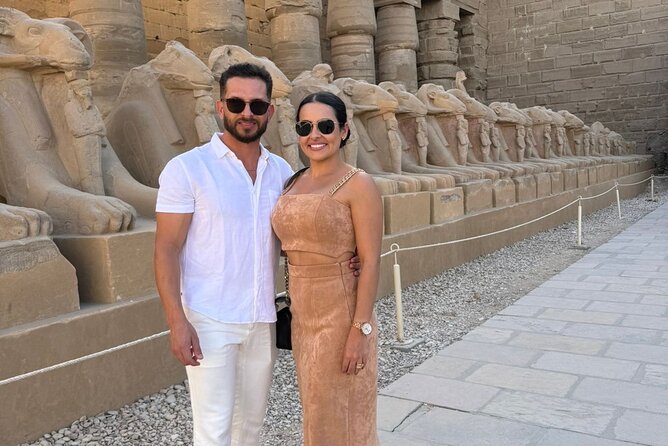
- Private, Egyptologist-led day so you can keep the story straight from pyramid builders to royal rituals.
- Camel ride with big views across the desert plus a dedicated panoramic photo stop.
- Giza sights grouped smartly: Great Pyramid, Khafre Valley Temple, and the Sphinx in one compact circuit.
- Nile felucca hour gives your eyes and legs a break after stone monuments.
- Lunch and food stops are built in, with options noted for vegetarian, vegan, and gluten-free needs.
How the VIP format makes Giza feel human again
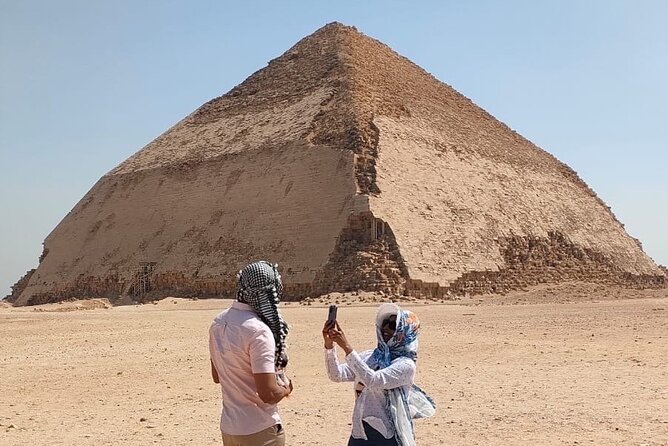
A Giza day can be chaotic fast. One person yells about tickets, another bargains for phone chargers, someone else is already lost. This tour leans the other way: it’s private, with your own group, and moves by a simple plan rather than a long queue shuffle.
The big win is your guide time. A professional Egyptologist guide helps you connect the dots while you’re still standing there, not later while reading your notes. In past experiences with this operator, you may meet guides like Hajer or Ibrahim, and drivers such as Mido, who were described as steady and attentive. That combination matters because Giza is huge, the lighting changes quickly, and small orientation mistakes cost you real time.
Then there’s the comfort factor. You’re in an air-conditioned vehicle, which is not a luxury detail in Cairo—it’s how you keep your energy for the walking and stairs. Even with a packed schedule, the A/C transfer time helps you reset between major stops.
The other practical advantage is skip-the-line. You’re still seeing iconic monuments, but you’re cutting down the waiting that can stretch a “quick stop” into an all-out hour loss.
You can also read our reviews of more tours and experiences in Cairo.

Camel ride across the desert: worth it, if you go with eyes open
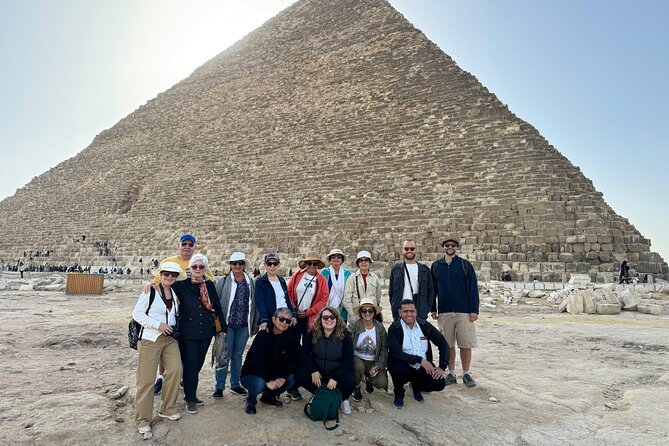
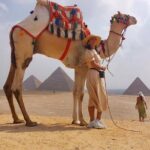
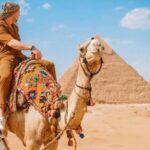
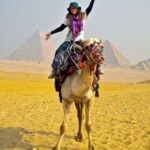
The camel ride is one of those experiences where expectations can run wild. Here, it’s framed as a short desert crossing with panoramic views of all three pyramids. The ride is about 20 minutes, and there’s a stop at a Panoramic Viewpoint for photos.
Is 20 minutes enough? For most people, it’s a good balance. Long rides can turn into endurance tests, and camel handling isn’t always smooth for everyone. Short and focused often means you get the best part—the view—without burning the whole day or losing patience.
A realistic tip: plan to wear something that won’t make you miserable in the sun and that you can keep flexible for getting on and off the camel. You’ll want shoes with grip, since the surrounding ground near viewpoints can be uneven. Also bring sunglasses and a hat. The desert light is unforgiving, and you’ll want to actually see the pyramids, not just fight glare.
If you’re photo-driven, the viewpoint stop is the payoff. You’re not just sitting on a camel; you’re getting a planned moment where the pyramids line up nicely for pictures.
Giza pyramids up close: Khufu, Khafre, and Menkaure explained fast
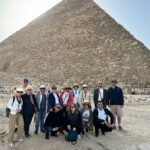
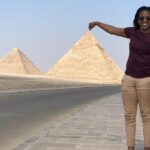
Once you’re on the plateau, the differences between the three main pyramids become obvious. The guide helps you read the shapes instead of treating them as identical stone blocks.
You’ll see:
- The Great Pyramid of Khufu (Cheops Pyramid), the largest and best-known.
- The Pyramid of Khafre (Chephren Pyramid), famous for its partially intact limestone cap.
- The Pyramid of Menkaure, the smallest of the three main pyramids.
That “what you’re looking at” part is where a good Egyptologist guide pays off. From a distance, the pyramids look like a row of monuments. Up close, you notice construction choices, the way materials sit, and why the Khafre pyramid is so distinctive.
A helpful way to experience this is to pick one feature per pyramid before you get there. For example, focus on the top finish on Khafre, then shift to proportions on Khufu, then compare how Menkaure looks smaller without feeling “boring.” Your brain handles the complexity better when you give it a job.
Also, the pacing matters. This kind of private schedule helps you stay present rather than rush through everything in a blur.
The Sphinx and Valley Temple: what to notice (and what you won’t)
Next comes one of the most famous statues on Earth: the Great Sphinx of Giza. You’ll stand by the lion body and human head figure, tied to the belief that it represents Pharaoh Khafre.
Here are the details worth holding onto while you’re there:
- It’s about 73 meters long and 20 meters high.
- It’s carved from a single piece of limestone.
- The nose is missing, likely due to erosion or vandalism.
- The Dream Stele of Thutmose IV sits between the paws and relates a story of a divine message received in a dream.
When you know about the Dream Stele, the Sphinx changes tone. It’s not just a scary guardian statue; it becomes part of a written story tradition. That helps you move past the “wow” moment and into real understanding.
You’ll also visit the Valley Temple of Khafre, described as well-preserved and linked to the mummification process. Valley temples are different from the big pyramid structures in how they feel. They’re more about rituals and access, which can help you see that the burial landscape wasn’t one single monument. It was a working sacred complex.
Practical note: the Sphinx area involves walking and standing in direct sun. I recommend you bring water, pause often, and don’t try to “power through” photos without breaks. Your pictures will look better, and so will your mood.
Beyond Giza: Bent Pyramid, Memphis, and Saqqara in a smart arc
A strong Cairo day shouldn’t be only one view, even when the views are world-famous. This tour includes a broader sweep that adds variety: you’ll see the Bent Pyramid, then head toward Memphis (once Egypt’s capital), and continue on to Saqqara.
At Memphis, you’ll inspect relics including broken columns and a giant fallen statue of Ramses II. This stop is valuable because it shows you that Egypt’s monuments weren’t frozen in time. Capitals change, power shifts, and stone remembers it.
Saqqara adds the “how big was their imagination” factor. It’s another major burial area, and it helps you see pyramids as part of a larger system. Even if you’re not memorizing dynasties, you’ll feel the difference between a single famous pyramid complex and a wider necropolis landscape.
One tip: keep your questions simple. Ask what changed over time, not just who built what. Your guide can connect the dots quickly—especially when you’re standing in the places where the evidence sits.


Cairo from water: the felucca hour that cools your head
After pyramids and temples, you might think you’ll be too tired to care about the Nile. Then a felucca ride happens, and the tiredness flips into relief.
A felucca is a traditional wooden sailing boat on the Nile. This tour includes about 1 hour on the water, and the point is straightforward: slow down. It’s a peaceful break from the city’s pace, and it gives you a different kind of Cairo perspective—more open sky, more movement, less stone.
Because it’s a boat ride, it’s also a change in lighting. Your camera will feel happier. Your brain will too. Even if you’re only focused on the monuments up to this point, the Nile angle gives you the sense of place that most land-only days miss.
Bring a light layer if you tend to feel chilly on boats, especially later in the day. The data here doesn’t specify clothing needs, so treat this as a general comfort move rather than a promise.
Lunch and Egyptian food: where the day becomes personal
Lunch is built into the schedule, and it’s not treated like a rushed afterthought. The tour includes lunch in a local restaurant, and it notes accommodation for vegetarian, vegan, and gluten-free needs. That matters because food is part of travel, and feeling cared for at lunch prevents the day from collapsing into “finding something later.”
The tour also includes bottled water, plus mineral water, snacks, and lunch. If you’re doing Giza in warm conditions, that hydration support is more valuable than it sounds.
In at least some days on this route, you may also encounter extra cultural stops tied to local crafts and products, like a papyrus manufacturing facility and a shop with oils and fragrances. Even if those stops are brief, they add texture to the day beyond pyramids and boats.
How I think about this for value: the $65 price isn’t just paying for entrances. It’s paying for the structure that keeps you fed, hydrated, and moving with less friction. When lunch and snacks are handled, you spend less energy negotiating or searching for food near major monuments.
The guide and driver piece: small details that save your day
This is where private service can either feel worth it or feel like marketing. In this case, the reports you have to work with are encouraging: guides and drivers like Hajer and Ibrahim were described as solicitous, thoughtful, and making the tour exceptional. There was also praise for planning and ongoing support, not just a driver dropping you at the gate.
What does that mean in real-life terms? It means you’re more likely to:
- get the timing right between stops,
- understand the monuments without guessing,
- and not get stuck waiting on basic things like your next direction.
Even the driver role is real here. When Mido was noted as driving tirelessly, that hints at the energy cost of crossing Cairo traffic while keeping a schedule. A steady driver helps you arrive ready instead of stressed.
Another small but meaningful feature is that you’re not sharing the day with strangers. It’s your group only, so the pacing is easier to control. If you need a photo break, you’re not waiting for someone else’s slow moment.
Price and value: why $65 can work for a full Cairo day
At $65 per person for a 6 to 8 hour private day, the value depends on what you care about.
If you want only a quick pyramid glance, you could do it cheaper on your own. But if you want an organized loop with an Egyptologist guide, included camel ride time, lunch, water, and a Nile felucca hour, the price starts looking more reasonable.
Also, you’re paying for reduced friction:
- air-conditioned transport,
- pickup offered,
- skip-the-line support,
- and a planned structure that prevents dead time.
That’s what makes the difference between a tiring “I saw it” day and a “I understood it” day.
Just keep expectations grounded: this isn’t an all-day lounging cruise. It’s a packed cultural program. If you like your time with breathing room, you’ll still find it here, but you’ll also want to accept that the day is busy.
Who should book this VIP tour (and who might rethink it)
This experience is a strong match if you:
- want a private Egyptologist-led day,
- care about understanding what you’re seeing at Giza and beyond,
- want both desert views and Nile time in one stretch,
- and value lunch and hydration handled for you.
It may be less ideal if you:
- strongly dislike camel riding or short animal interactions,
- have trouble with walking on uneven ground and moving between several sites,
- or want a slow, minimal itinerary.
If you’re somewhere in the middle, you can still make it work. Tell your guide early where you need slower pacing. Private service is best used that way.
Should you book this VIP private Giza pyramids + camel ride + lunch + felucca tour?
I’d book it if you want a structured Cairo day that hits the big icons without turning into a logistics headache. The mix of Giza pyramids, a desert camel ride, an Egyptologist guide, lunch, and a felucca hour is a smart combo, especially if it’s your first (or only) time in the area.
I’d think twice if mobility or comfort is a big concern for you, or if you dislike tight schedules. But if you’re okay with some walking and heat management, this tour gives you a lot of experience per hour, with practical support built in.
FAQ
How much does the tour cost?
The price is $65.00 per person.
How long is the tour?
It runs about 6 to 8 hours.
Is pickup included?
Pickup is offered.
Is this tour private?
Yes. It’s a private tour/activity, and only your group will participate.
What transportation do you use?
You travel in an air-conditioned vehicle.
What’s included with the tour?
The tour includes air-conditioned vehicle, lunch (with dietary accommodation such as vegetarian, vegan, gluten-free), bottled water, and skip-the-line.
Does the tour include camel riding and felucca?
Yes. It includes a camel ride experience (about 20 minutes) and a felucca ride (about 1 hour).
Are tickets included for attractions?
The details provided say the camel ride has an admission ticket included, and lunch includes an admission ticket. Other listed stops show admission ticket free, and skip-the-line is included.
Who can join the tour?
Most travelers can participate.
What’s the cancellation policy?
Free cancellation is available. You can cancel up to 24 hours in advance for a full refund. If you cancel within 24 hours, the amount paid isn’t refunded.