REVIEW · CAIRO
VIP Private Day Tour Giza Pyramids, Memphis and Sakkara Pyramids
Book on Viator →Operated by Hesham Egypt tour guide · Bookable on Viator
One day in Cairo, three ancient powerhouses. This VIP private day tour strings together UNESCO heavy hitters—Giza, Saqqara, and Memphis—guided by an Egyptologist with hotel pickup and drop-off, so you’re not spending your day negotiating Cairo’s traffic. A mobile ticket and bottled water help keep the day smooth.
What I like most is the hotel pickup that saves you hours of hassle and gets you onto the Giza Plateau while the lighting is still decent. I also like that a camel ride and entrance fees are listed as included, which helps you control the budget before you arrive. The main consideration is simple: it’s an 8-hour circuit, so you’ll need to move with purpose if you want extra time for photos and quiet reading at each stop.
In This Review
- Key highlights to know before you go
- VIP Price Check: what $19 per person really means
- Hotel pickup in Cairo: turning traffic time into pyramid time
- Giza Plateau: Cheops, Khafre, and Menkaure without the scramble
- The Great Pyramid of Khufu: facts that make the monument feel real
- Khafre and Menkaure: the quick stops that still add up
- The Great Sphinx: your face-to-face moment
- Camel ride included: fun factor, comfort factor, and what to confirm
- Saqqara pyramids: where the story broadens beyond Giza
- Mit Rahina Museum (Memphis open-air): finishing with the ancient capital vibe
- Time management: how this 8-hour loop usually feels
- What to ask your Egyptologist guide (so the day feels personal)
- Who this tour fits best (and who might prefer something else)
- Should you book this VIP private day tour?
- FAQ
- Is this a private tour?
- How long is the tour?
- Do you provide hotel pickup and drop-off?
- What’s included in the price?
- Are entrance tickets included for each stop?
- Is there an extra cost for certain hotel areas?
- What is the child rate?
- What is the cancellation policy?
Key highlights to know before you go
- Private, Egyptologist-led pacing: you get context as you walk, not just a checklist of monuments
- Giza Plateau focus: Cheops, Khafre, and Menkaure are covered with smart time splits
- The Sphinx stop is built in: you’ll have dedicated time at one of the most iconic faces in the world
- Saqqara necropolis time: enough minutes to feel the scale and the changing royal burial ideas
- Memphis via Mit Rahina Museum: you finish with open-air ruins tied to Egypt’s ancient capital
VIP Price Check: what $19 per person really means
At around $19 per person, this tour sits in the “serious value” category—especially because it’s positioned as private and includes hotel pickup, bottled water, and a private vehicle. The value gets even better if the entrance fees and camel ride are truly part of your package.
That said, don’t be shy about confirming what exactly is covered at the moment you book—especially around site entry, time in specific areas, and any add-ons you might want. Cairo is famous for ticket rules that can vary by route and access.
You can also read our reviews of more tours and experiences in Cairo.

Hotel pickup in Cairo: turning traffic time into pyramid time
Cairo traffic can chew up a day fast. The payoff here is the hotel pickup and drop-off, which means you’re not hunting taxis, working out directions, or timing your own transfers across the city.
You also have a private vehicle, so you can keep the day efficient between Giza, Saqqara, and the Memphis area. That matters because you’re not just visiting sites—you’re also traveling between them, and that travel time is part of your “8-hour day” reality.
Giza Plateau: Cheops, Khafre, and Menkaure without the scramble
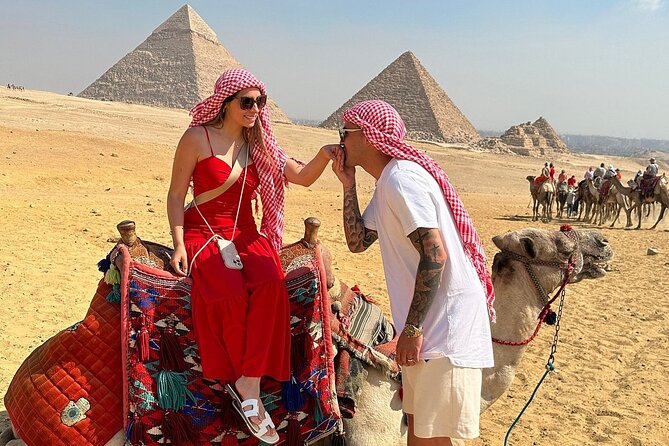
Giza is one of those places where your brain needs a minute just to catch up. From the moment you arrive, the scale hits you: a whole royal skyline built as tombs, created for kings (and, in a wider sense, royal funerary power) in Egypt’s Old Kingdom world.
You’ll start with a general walk around the main pyramid area, then focus your time on the main monuments:
- Great Pyramid of Cheops (Khufu): the biggest and most intact, once counted among the Seven Wonders, and for about 4,300 years the tallest building on Earth until the Eiffel Tower went up in 1889. It’s built of limestone blocks—about 1,300,000 of them—ranging from roughly 2.5 tons to 15 tons.
- Pyramid of Khafre: the one people often think is taller because of the visible casing stones near the top and the higher position on the plateau. It’s actually shorter, and the difference is part of the story you’ll hear on-site.
- Pyramid of Menkaure: the smallest of the three main pyramids on the plateau, but still packed with details about construction changes and how burial corridors evolved over time.
The practical upside of a guided route here is that you’re not wandering randomly across the plateau. You’re moving with a plan, and the guide’s context helps you notice things you’d likely miss on your own.
The Great Pyramid of Khufu: facts that make the monument feel real
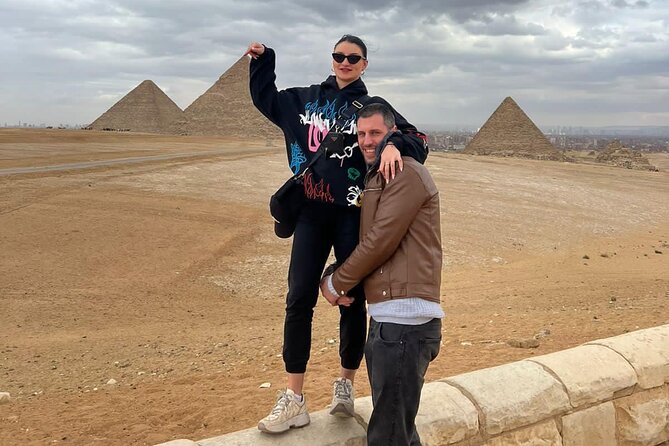
You’ll spend a focused chunk of time at Khufu, and that’s the right approach. When you get even basic specifics—like that the pyramid’s four sides face the cardinal points—your photos stop being just photos. You start collecting tiny “why this mattered” details.
If you like architecture or systems thinking, Khufu delivers. The pyramid’s square base measures around 13 acres, and the sides are about 230 meters long, with an angle of about 52 degrees. Those numbers don’t replace the view, but they help your brain hold onto what you’re seeing.
Also keep in mind you’re dealing with a massive open site. Heat and sun change fast, so a guide-led schedule helps you catch the best moments rather than getting stuck waiting for the group to decide what to do next.
Khafre and Menkaure: the quick stops that still add up
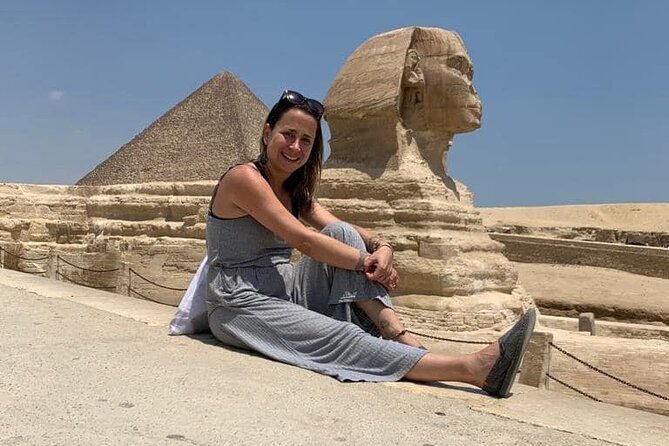
Khafre and Menkaure may get shorter time blocks, but they’re not throwaway stops. Each one has a clear “reason to care,” and the guide can point you toward the features people usually miss.
Khafre is the one with the noticeable remaining casing stones near the summit. Menkaure has its own construction story, including how the pyramid’s internal layout changed during and after building—information that makes the smaller monument feel just as purposeful.
If you’re the type who wants to read every inscription and linger, you might feel the time pressure at these two. If you’re okay with a well-directed route—good at taking in the big idea and snapping a few solid photos—these stops are exactly what you need.





The Great Sphinx: your face-to-face moment
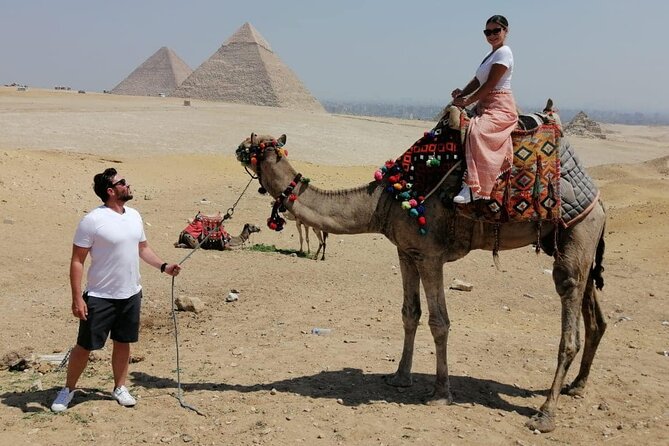
The Sphinx is free on the grounds for visitors, and that makes it a smart, no-pressure stop. You’ll likely spend around 20 minutes here, which is enough to get oriented and take in the full shape: roughly 60 meters long and about 20 meters high, with a face around 4 meters wide.
The guide’s job is to connect the visual to meaning. You’ll hear that it’s carved from soft sandstone, and that the face is oriented toward sunrise in the ancient worldview. The Sphinx also ties to royal worship—there was a temple built in front of it—so you’re not just looking at a sculpture. You’re standing at a symbol.
Practical tip: the Sphinx area can be windy and sunny. If you’re sensitive to sun glare, bring sunglasses and plan for a quick shade break rather than trying to sit there for a long stretch.
Camel ride included: fun factor, comfort factor, and what to confirm
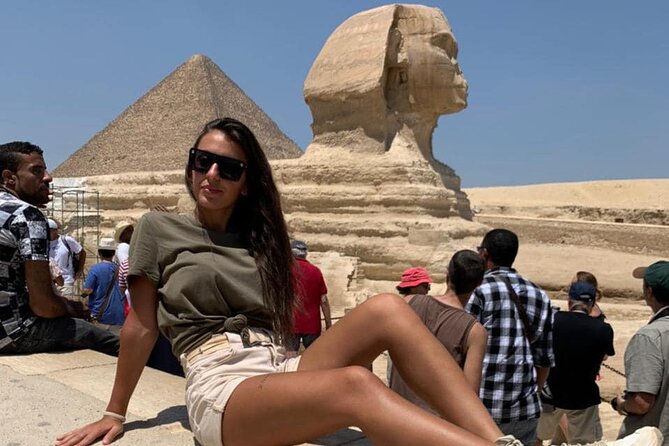
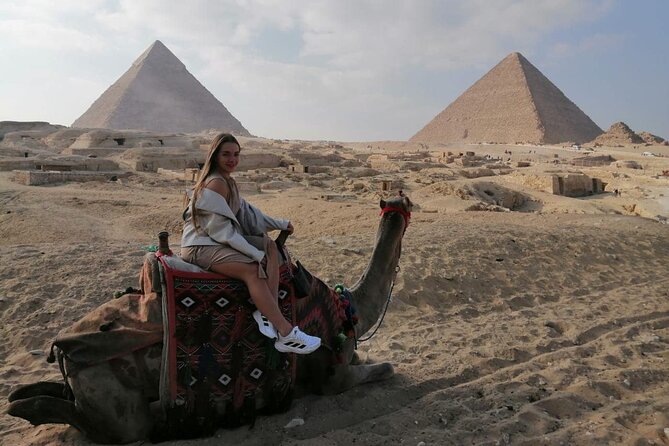
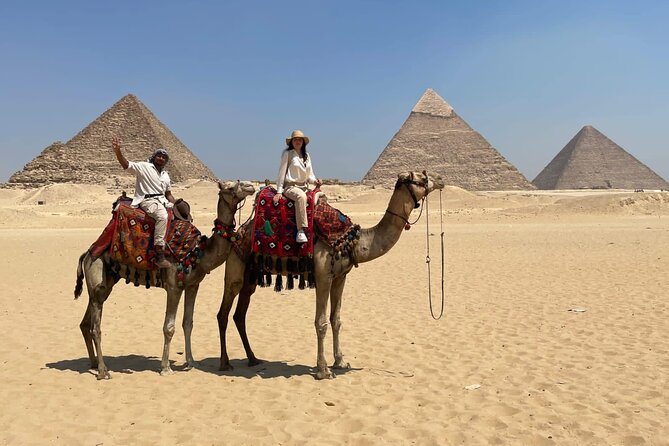
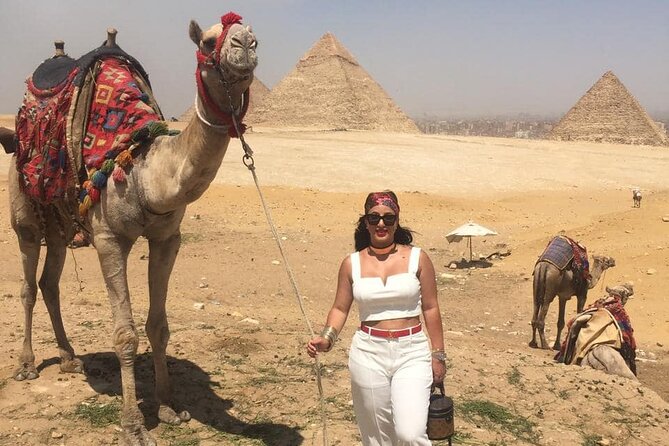
A camel ride is listed as included, which is a big reason many people book this style of tour. It’s also one of those activities where conditions can affect how enjoyable it feels.
Since you don’t control the schedule, ask your guide at the start of the day how the camel ride fits into your timing. Also confirm where the ride starts and how long it typically lasts within the overall plan.
For comfort, simple planning helps: closed-toe shoes, sunscreen, and water (you’ll have bottled water on board). If you’re not feeling great with animals or you’d rather prioritize walking and photos, you should still be honest early so the day stays comfortable.
Saqqara pyramids: where the story broadens beyond Giza

Saqqara is where you start to feel the bigger timeline. It was one of the primary cemeteries for the former capital of Egypt, Memphis, and the site is described as extensive and still not fully explored compared to how much has already been found.
You’ll spend about 1.5 hours here, which is the sweet spot for Saqqara. It’s long enough to wander with purpose and short enough to keep energy for the final stop. The payoff is that Saqqara isn’t just “more pyramids.” It’s the sense of an entire necropolis system—royal burials, evolving practices, and a place that kept mattering across generations.
If you like photography, you’ll find angles and textures that feel different from Giza’s plateau. If you like archaeology context, this is where the guide’s Egyptologist explanations can really turn the day from sightseeing into understanding.
Mit Rahina Museum (Memphis open-air): finishing with the ancient capital vibe
The day’s ending makes sense: you head to Mit Rahina Museum, an open-air setting associated with Memphis. It’s described as a must-see, and it’s close enough that you’re not spending the last hour stuck in transfers.
This is where you shift from giant pyramid silhouettes to a more human-scale sense of an ancient city. Instead of chasing monument size, you’re looking at remnants and open-air pieces that help connect the capital’s real world to the tomb cities you visited earlier.
You’ll get about 30 minutes here. That’s not a full museum deep dive, but it’s enough to leave with a mental map: Memphis wasn’t just a name on a history chart. It was tied to the cemeteries around it, including Saqqara.
Time management: how this 8-hour loop usually feels
This tour is built around multiple major sites in one day, so your time is naturally partitioned. Expect a structured flow:
- Giza Plateau coverage early
- A deeper focus on Khufu, then shorter stops on Khafre and Menkaure
- Dedicated Sphinx time
- Saqqara with enough walking time to feel the scale
- A final open-air stop tied to Memphis
The practical result: you won’t feel like you’re starting over every hour. You’ll feel like you’re moving along a line from Old Kingdom symbol to necropolis system to capital ruins.
If you’re the type who wants to slow down at every photo spot or read every panel for long stretches, plan to accept a quicker pace or book a different format with fewer sites.
What to ask your Egyptologist guide (so the day feels personal)
You’re paying for more than vehicle transport. A guide with Egyptology knowledge should help you translate stone into story.
Here are smart questions to keep in your pocket:
- What’s the key difference in royal tomb purpose across the periods you’re seeing?
- Why do Khafre and Khufu look so different from certain angles?
- What’s the most important thing to notice at Saqqara that connects back to Memphis?
- How should I think about the Sphinx as a cultural object, not just a landmark?
When you ask questions like this, the tour stops feeling like a timed walk and starts feeling like you’re building a timeline in real space.
Who this tour fits best (and who might prefer something else)
This is a strong choice for you if you want a private day with an expert guide and a tight route that hits the biggest archaeological names around Cairo. It also works well if you want certainty: pickup, transport, bottled water, and a planned structure.
It may not be ideal if you want unhurried time at fewer sites, or if you’re someone who needs long pauses to absorb every detail. In that case, you might prefer a slower itinerary that gives each monument its own breathing room.
Should you book this VIP private day tour?
If your goal is a high-impact day—Giza’s pyramids and Sphinx plus Saqqara and Memphis—this is a solid value, especially at the stated price point. The combination of private vehicle + Egyptologist guide + included camel ride/entrance fees can make the day feel both exciting and easy to manage.
Before you book, do one quick check with the operator about what entrance fees cover on the day and how the camel ride timing is handled. If you’re happy with an 8-hour “see the highlights with context” format, I’d say this one is worth your time.
FAQ
Is this a private tour?
Yes. It’s listed as a private tour/activity, meaning only your group participates.
How long is the tour?
The duration is about 8 hours.
Do you provide hotel pickup and drop-off?
Yes. Hotel pickup and drop-off are included.
What’s included in the price?
The tour includes all taxes, bottled water, private vehicle transport, the private tour, and hotel pickup and drop-off. Entrance fees and a camel ride are also listed as included.
Are entrance tickets included for each stop?
Entrance fees are listed as included. At least some sites are described as free or with admission notes, so it’s worth confirming the exact ticket coverage for the specific stops you want to focus on.
Is there an extra cost for certain hotel areas?
Yes. Airport and hotels within NASR City, 6th Oct City, and New Settlement area have an additional charge of $30.
What is the child rate?
Child rates apply only when sharing with 2 paying adults.
What is the cancellation policy?
Free cancellation is available. You can cancel up to 24 hours in advance for a full refund. Canceling less than 24 hours before the start time does not get a refund.


![[Once-in-a-Lifetime Experience]Tokyo City Go-Kart Experience Tour - Safety and Driving Requirements: The Part You Can’t Skip](https://cd.viptourlover.com/wp-content/uploads/once-in-a-lifetime-experience-tokyo-city-go-kart-experience-tour-400x267.jpg)